
A Bit About Elaine de Kooning
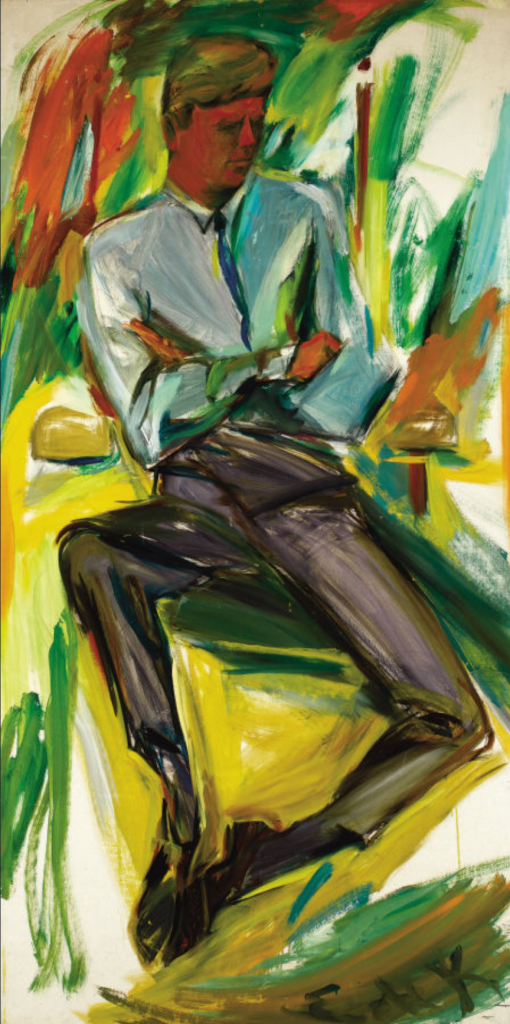
Abstract Expressionism is gestural and spontaneous yet so accurate in capturing explosive emotions in a specific moment in time. While abstract expressionism was developed by American artists Jackson Pollock, Mark Rothko, and Willem de Kooning, in this entry we will be looking at Elaine de Kooning and her work of the President of the United States, John F. Kennedy.
Elaine de Kooning is an interesting artist to look at as she is known for not aligning with the normal realm of abstract expressionism. While the discipline itself is eccentric, de Kooning still proposes a distinctive style as she sensitively depicts such dynamic and powerful poses of her subjects. In addition to this, throughout her 40-year career de Kooning painted a wide range of objects from basketball players to Bacchus statues, but it was clear that portraiture was her passion.
Within her passion of portraiture, painting men, and more specifically her series “faceless men”, she integrated a wonderfully complicated and controversial message into the art world and society, and she undoubtably left her footprint within art history because of this. She approached her depictions of men with a new perspective. Elaine was interested in capturing the nuance of body language and therefore diverted away from facial features, simultaneously turning the tables on the male gaze. “De Kooning’s portraits of men are fascinating because she reverses the standard male artist/female model dynamic and in many of her portraits she captures the sexual power of her subjects, challenging the male privilege of looking and female role of object to be looked at.” (Stahr, 2003)
Elaine de Kooning’s 1954 portrait of Artist Fairfield Porter epitomises her intentions so clearly. His legs provocatively widely spread, makes us focus on the body language emphasising him as the object within this piece. Moreover, the lack of clarity within the face combined with the increased analysis of the body language leaves us to infer that he is looking directly at the viewer with a confident and comfortable manner.
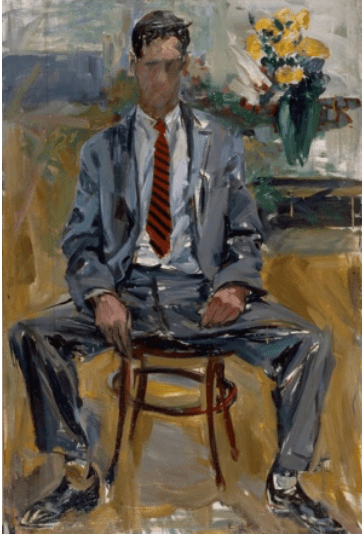
To focus more on the body language, Elaine de Kooning obscures her subjects faces. When paining one of her close friends from New York, poet, Frank O’Hara, she said she “first painted the whole structure of his face, then wiped out the face, and when the face was gone, it was Frank than when the face was there.” (Mendelsohn, 2018)
This highlights how she possibly wanted to encapsulate the inherent nature of the subject and the face was not necessary for that. Brandon Fortune, chief curator of the National Portrait Gallery in Washington, D.C., and organizer of the 2015 exhibition “Elaine de Kooning: Portraits built on this by saying “she wanted to capture the pose of the whole person, the way you’d see someone from a distance and know who they were,”. (Mendelsohn, 2018)

Click Here For The Full Commentary On Elaine de Kooning’s ‘John F. Kennedy’
 Noticing Art