
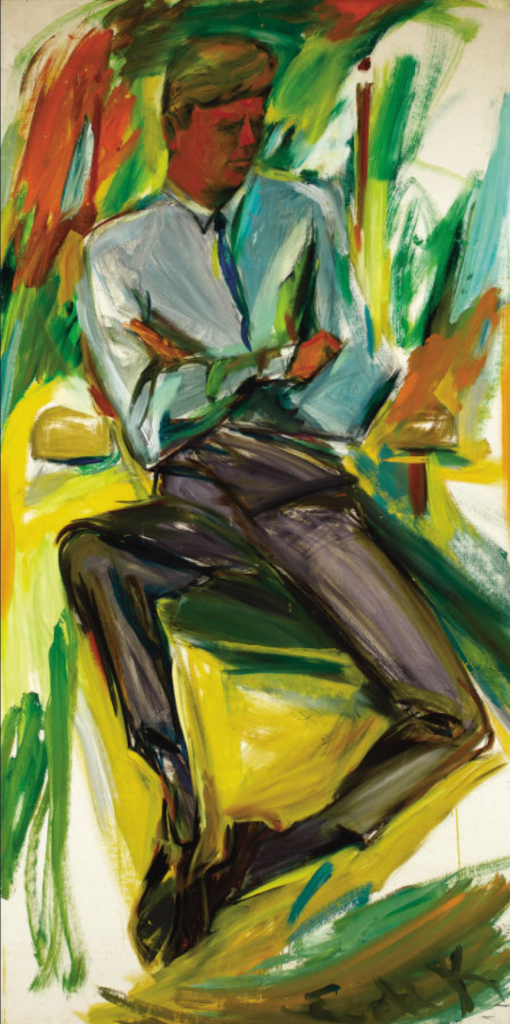
The main piece of artwork that I will be talking about is one from Elaine de Kooning’s 9-piece collection of John F. Kennedy. In 1962 de Kooning received a commission to paint Kennedy, not only because her speed would allow her to capture the president’s nature but because of her unique presence within the new abstract expressionism movement. Elaine de Kooning’s paintings of John F Kennedy are currently housed in the national portrait gallery inn Washington DC.
Within this piece there seems to be numerous sharp, straight, diagonal lines. While at first this slanted depiction generates a sense of tension or unease, the fact that these lines do not parallel each other; combined with his legs spread open and the explosion of bold colours surrounding him, creates a feeling of energised movement. This is corroborated by the fact that Elaine de Kooning said “All my sketches from life … had to be made very quickly, catching features and gestures, half for memory, even as I looked, because he never sat still. It was not so much that he seemed restless, rather, he sat like an athlete or college boy, constantly shifting in his chair.” This idea that he was constantly moving stood out to me. I could not help but wonder if he had ADHD and to satisfy my curiosity, I read through a couple articles; finding one called ‘Paying attention to ADHD’ by Micah Dorfner. It highlighted that John F Kennedy did in fact have ADHD (Dorfner, 2015); possibly explaining the constant movement that de Kooning so effortlessly translated into this piece.
The lines which clearly depict a bodily figure, where we can just about make out the face are bold yet fleeting. While this style does align with de Kooning’s type of work, I could not help but link this to the fact that her full understanding of John F Kennedy was never complete. Throughout de Kooning’s process of completing this commissions Kennedy was assassinated on the 22nd of November 1963. The disquieting news about the president, forced de Kooning to stop painting for months as “she was just so moved by the erasure of this man from the world” says Fortune (George, 2020). Through reading about De Kooning’s journey with this commission, especially after Kennedy’s assassination; even though the piece was finished, there is a constant reminder that it was very difficult to truly capture and revive his nature as he was so abruptly removed from society.
Within this piece there are complementary colours such as the green and red and blue and orange. Complementary colours are two colours on the opposite side of the colour wheel. They can be used to make each other appear brighter, or they can be used to make neutral colours and shadows. Some examples of complementary colours are Red and green; yellow and purple; orange and blue; green and magenta. However, while they are named complementary colours this can be quite deceiving as looking at them unmixed and in their primitive form can be quite jarring as they do not necessarily sit well in the eyes of the viewer. Elaine de Kooning utilises these complementary colours to create a sense of, which perfectly reflects the atmosphere from which the president would have been in as he was constantly moving, talking on the phone, and meeting people as de Kooning has mentioned.
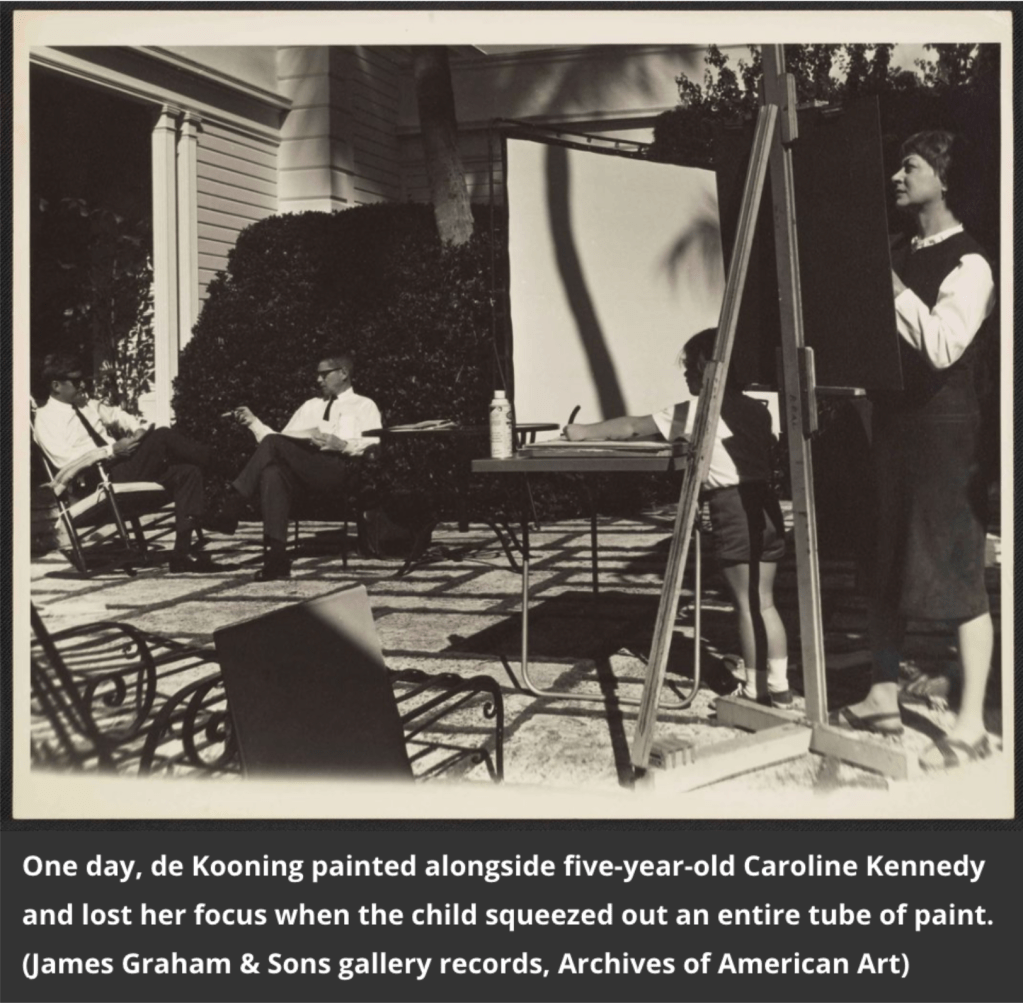
While it could be argued that this piece has some connotations of control and authoritative power, I can’t help but disagree to a certain extent. I think my disagreement comes from the extra reading and research I have done. While looking at the piece, the crossed arms and stern and straight face resembles a closed off nature. This is contradicted by the spread, relaxed legs, and coloured background which I think resembles youthfulness, and calmness. Moreover, the fact that Kennedy let Elaine de Kooning sit in on his personal time, conferences, and briefings, generates this image of trust and humility from Kennedy. Moreover, Kennedy’s daughter would paint alongside de Kooning which further exhibits this safe and relaxed atmosphere which also translates into this piece, rather than a complete authoritative nature. Therefore, while this abundance of power is undeniable it would be wrong to suggest that this piece only depicts this, because of the relaxed atmosphere and bright colours that de Kooning exhibits.
 Noticing Art