Curating

Can exhibitions present histories of art in ways that texts cannot?

Art history has traditionally been conveyed through written texts such as scholarly books, articles, and catalogues that analyse artists and movements. However, museums and galleries offer an alternative medium for presenting art history: the exhibition. This raises the question of whether exhibitions can present the histories of art in ways that texts cannot. Exhibitions provide a direct, experiential encounter with artworks, engaging viewers’ senses and emotions in a physical space that texts cannot fully replicate. They enable curators to craft a spatial narrative through the selection and arrangement of objects, immersing viewers in an environment that conveys context and meaning. At the same time, however, exhibitions are not inherently self-explanatory and rely on textual context such as wall labels and catalogues, to anchor the display in history and avoid misinterpretation. This essay argues that, while exhibitions offer an immersive experience beyond the capacity of text alone, they work best in tandem with textual information to provide both emotional impact and historical accuracy. The case of the Paula Rego retrospective at Tate Britain in 2021 will illustrate how an exhibition can successfully integrate immersive visual storytelling with contextual depth to present art history in a nuanced way.

One of the greatest strengths of exhibitions is their ability to deliver an immersive experience of art that a text simply cannot provide. Viewing an artwork in person is a profoundly different experience from reading about it or seeing a small reproduction on a page. Exhibitions allow viewers to encounter the authentic objects themselves, preserving this visceral feeling. In person, one can move around the artwork, observing how light plays on its surface and how brushstrokes create texture and depth, qualities that are not available in a reproduction or textual description​. Exhibitions also engage multiple senses and create an environmental context for art. Unlike a text, which primarily engages the intellect through reading, a well-designed exhibition can appeal to sight, touch and sound. Galleries often use lighting, spatial design, and occasionally audio or interactive elements to shape the visitor’s experience. These sensory cues immerse visitors in the artwork’s world. In a book, an author can only describe the appearance or effect of an artwork; in an exhibition, the viewer physically experiences it. The impact is often more visceral and memorable. The painting Angel by Paula Rego, made in 1998, confronts viewers at life-size with a figure wielding a sword and sponge, an image whose emotional intensity and scale could never be fully captured by words alone.

Beyond individual sensory experiences, exhibitions can convey narratives and interpretative arguments through spatial arrangement, something fundamentally different from the linear narrative of a written text. Curators act as storytellers, deciding which artworks to include and how to organise them so that, as visitors move through the exhibit, they encounter a sequence of ideas or historical developments. Art exhibitions have increasingly been understood, not just as displays of art, but as narrative forms in their own right. As Saloni Mathur observes, an exhibition often “emerges as a text woven from a great many threads”, incorporating divergent aesthetic viewpoints, historical contexts, and ideological layers, all staged together as “visual and curatorial arguments.” The exhibition itself functions as a complex narrative, woven through the selection and juxtaposition of artworks and the design of space. Art historian Caroline Jones likewise suggests that exhibitions constitute a “modern type of argument” about art history. An exhibition’s thesis is not conveyed through paragraphs, but through the arrangement of objects, images, and information in a physical space, a form that can reveal broad cultural narratives or, alternatively, reflect the singular vision of a curator. This mode of storytelling allows exhibitions to present art history in ways that textual narratives cannot easily emulate. 

Tate Britain’s 2021 retrospective of Paula Rego illustrates how an exhibition can shape art history differently from text-based narratives. Curated by Elena Crippa and Zuzana Flašková, the retrospective was designed to tell the story of Rego’s life and career while embedding her work within its socio-political context. Rego grew up under Portugal’s Estado Novo dictatorship, a repressive regime that censored artists and suppressed political dissent. Her work also responded to feminist struggles, particularly the fight for reproductive rights, as seen in her Abortion Series in 1998, which depicted women undergoing illegal abortions in response to Portugal’s failed referendum on abortion rights. Unlike a monograph or scholarly text, that would present Rego’s themes in a structured argument, the exhibition allowed visitors to physically move through her artistic evolution, experiencing the themes, media, and personal narratives directly. The exhibition’s spatial design contributed to its storytelling. Each gallery space was arranged thematically rather than strictly chronologically, juxtaposing works from different periods to highlight recurring motifs in Rego’s art, such as female agency and resistance. Curators like Okwui Enwezor have advocated for exhibition strategies that move beyond the traditional canon. Enwezor emphasised curating within culture, meaning that exhibitions should engage with historical, social, and political realities rather than presenting art as a purely formal exercise. His curatorial approach at Documenta 11 in 2002 exemplified how exhibitions could broaden art historical narratives by incorporating non-Western perspectives, thus challenging the dominance of the white cube’s selective memory. Rego’s retrospective actively resisted the neutrality of the white cube by embedding contextual materials throughout the exhibition. Wall texts, archival photographs, and recorded interviews provided a look into Rego’s influences, her personal struggles, and the political landscapes that shaped her work. This method aligns with Enwezor’s notion of curating beyond the canon, as it situated Rego’s work within a broader feminist discourse rather than isolating it as autonomous artistic production.

To illustrate the irreplaceable role of exhibitions in presenting art history, it is useful to contrast them with cases where art is only known through text, such as the 1950s–60s performance art movement, particularly Allan Kaprow’s 18 Happenings in 6 Parts in 1959. As performance art is ephemeral by nature, much of what remains of these works are written descriptions, photographs, and scripts. Scholars can reconstruct Kaprow’s performances through textual analysis, but no amount of description can replicate the immediacy of being present in the moment the sound, movement, and audience interaction that defined the work. This demonstrates the limits of text in capturing the full essence of certain artistic expressions. On the other hand, the modernist exhibition paradigm, epitomised by Brian O’Doherty’s concept of the white cube, presents a significant danger of exhibitions, gallery spaces and museums without the text, in the way it strips artworks of their historical, social, and cultural contexts, reinforcing a false sense of neutrality. By displaying art in pristine, white-walled spaces that suggest a timeless and universal aesthetic, exhibitions can create the illusion that meaning is inherent in the form alone, detached from the complexities of its creation and reception. This decontextualisation not only distorts how viewers engage with artworks but also reinforces a Eurocentric, modernist canon that prioritises formalist interpretations over lived experiences. Thomas McEvilley likens the atmosphere of these galleries to that of a religious sanctuary, where art is revered in silence, discouraging discussion of its broader implications. By demanding that viewers focus solely on form, the white cube enforces a detachment from the realities that shaped the work. This erasure is far from neutral; rather, it marginalises narratives that challenge dominant Western art-historical perspectives and naturalises a selective version of history that aligns with institutional biases. Without accompanying textual or contextual elements, such as historical framing, interpretative texts, or critical discourse, exhibitions risk presenting art in an ahistorical vacuum, reinforcing hegemonic structures and limiting the potential for diverse interpretations.

Exhibitions and texts serve distinct yet complementary functions in the presentation of art history. This essay has highlighted that exhibition, through their immersive environments, spatial storytelling, and curatorial narratives, offer unique ways of engaging with art’s past that texts alone cannot achieve. The 2021 Paula Rego retrospective at Tate Britain exemplified how exhibitions can foreground context, interactivity, and thematic connections in ways that written accounts struggle to convey. However, text remains vital in framing, documenting, and interpreting art history. The most effective approach, therefore, is one that recognises the combination of both exhibition and textual narratives.
Cultural Revolution – A Break From The Past?

The Cultural Revolution in Mao’s era was a clear break away from the past. The cultural revolution launched in 1966 aimed to purge Chinese society of bourgeois elements and promote proletarian culture. Mao encouraged the creation of revolutionary art that glorified the Communist party, the working class, and the ideals of the revolution and this led to the proliferations of art forms such as propaganda posters. This essay will highlight how the purpose of these posters was to further promote Mao and the Chinese Communist party throughout society. Mao understood that art could be politicised and spread throughout society in order to spread his ideology and doctrine in a way that seemed uncoerced and nonviolent. This is supported by his notion of the purpose of art. Mao stated in his 1942 lectures that “there is no such thing as art for art’s sake”[1] and that a political criterion was primary while an aesthetic criterion was secondary. This essay will argue that while the Cultural Revolution itself had a drastic impact on the traditional Chinese culture that existed in the past, it will also recognise that this cultural shift was not unexpected and had been growing since the communist takeover in 1949.

The strong need for a focus on the visuals and in turn this Cultural Revolution stemmed from the fact that Mao and the Communist Party were limited in the ways in which they could communicate with the working class. Mao stated that in order to “defeat the enemy we must rely primarily on the army with guns. But this army alone is not enough; we must also have a cultural army which is absolutely indispensable for unity our own ranks and defeating the enemy”.[2] This demonstrated that in order to have a successful army and nation use culture would allow him to infiltrate the minds of society. Robert Benewick also argued that “no doubt visual representation was also expedient given the limited means of alternative communication, the peoples limited literacy and Mao’s limitations as a public speaker”. This proliferation of posters and visual propaganda combined with the limited forms of communications resulted in a concentrated focus on these posters and as a result a concentrated focus on Mao’s ideology. Mao’s intentions were “to press ahead with one heart and one minds, to discard what is backwards and develop what is revolutionary”.[3] This created a personality cult for Mao where individuals lost their sense of self and opinions, “submitting to a higher ideological cause”.[4] The loss of self-identity and expression was instilled through creating punishment of anyone that deviated from the artistic guidelines. For example, painting the image of Mao in ways that departed from the approved version could earn the artist condemnation as a counterrevolutionary, as was the case with a Mao-badge designer from Inner Mongolia who altered the profile of Mao to face right and not left.[5] Patricia Powell and Joseph Wong stated that “pictures of Mao were posted everywhere, quotations from Mao were recited ritually, and revolutionary songs were sung religiously. People’s daily lives were inundated with the images, sounds, and ideas of Mao”. [6] In addition, the Little Red Book which was a collection of quotes from Moa’s speeches was carried by young people religiously. “One woman recalled that “we vowed . . . to submit ourselves unquestioningly to the control of the Great Leader Mao… Many people had been reduced to a state where they did not dare even to think”.[7] Benewick posited that as there was no physical or political space to challenge Mao, he had reached is totalising power paralleling the slogan “the whole country is red”.[8]

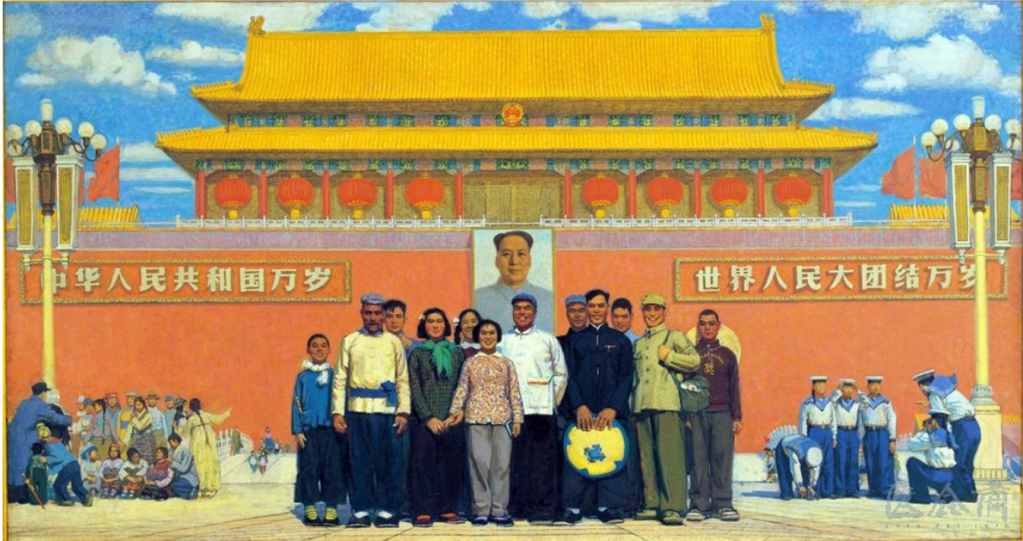
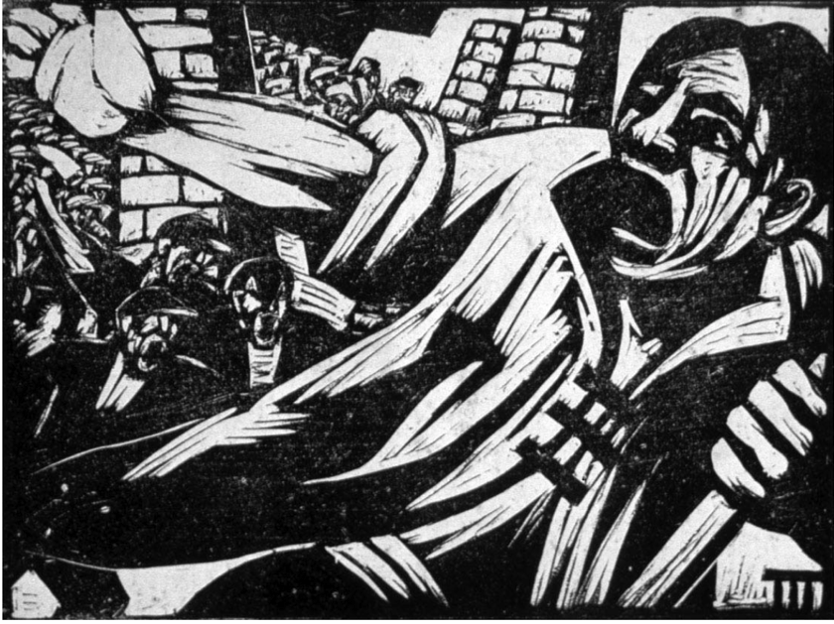
We can see this use of art as a radical break from the past as while there are characteristics of traditional Chinese art still presents within these posters, for the most part their use and purpose diverts from the realm of societal elites to peasants and the working class. However, it cannot be ignored that this breaks away from tradition did not begin in 1966 but began before that in 1949 when the Communist Party came into power. Moa took control over the art education in China and regulated art schools such as Central Academy of Beijing encouraging artists to paint images of Mao, the rural peasantry, and this sense of progress. Not only was the propaganda subject a break from the past but also the artists within these spaces drifted from an upper-class and middle-class activity to a lower-class endeavour. We see this shift when we compare the artwork that was being produced during the Japan’s invasion of China in 1931 compared to the era of Mao. This is illustrated in figure 1 and 2. In the woodcut here we can see a use of dark heavily inked illustrations of the cry if the Chinese people. However, in figure 3 the use of bright colours and the illustrations of the working-class people united in front of the portrait of Mao represents a nation that is at peace, happy and patriotic under the ruling of Mao.  Powell and Wong reinforce this through stating that “viewers familiar with the long tradition of Chinese art often note how un- Chinese these posters appear. Neither the poster format nor the media in which they were executed was typical of traditional Chinese art, where brush and ink is the usual medium and where illustrations customarily used the woodcut technique”.[9] Furthermore, works that were considered traditional such as guohua which was the traditional medium of brushwork and ink on handscroll, paper or silk were gradually eradicated under Mao. This is because of the courtly associations and the fact that the training in brushwork and calligraphy was not accessible to the working class and peasants. This reinvention of traditional works is seen through the gouhua artist Fu Baoshi and the landscape painting in figure 4. While this painting is carried out in the traditional guohua style there are various political indication within this. For example, the painting depicts a line from one of Mao’s poems called Snow in which he describes gazing over the northern landscape, and we again see a distinct red sun.

Figure 1
Hu Yichuan, To the Front!, woodcut, 1932, 9 1/8 X 12.” Lu Xun Memorial, Shanghai.x
Figure 2
Sun Zixi, In Front of Tiananmen, 1964. oil on canvas, 153 x 294 cm. National Art Museum of China, Beijing.

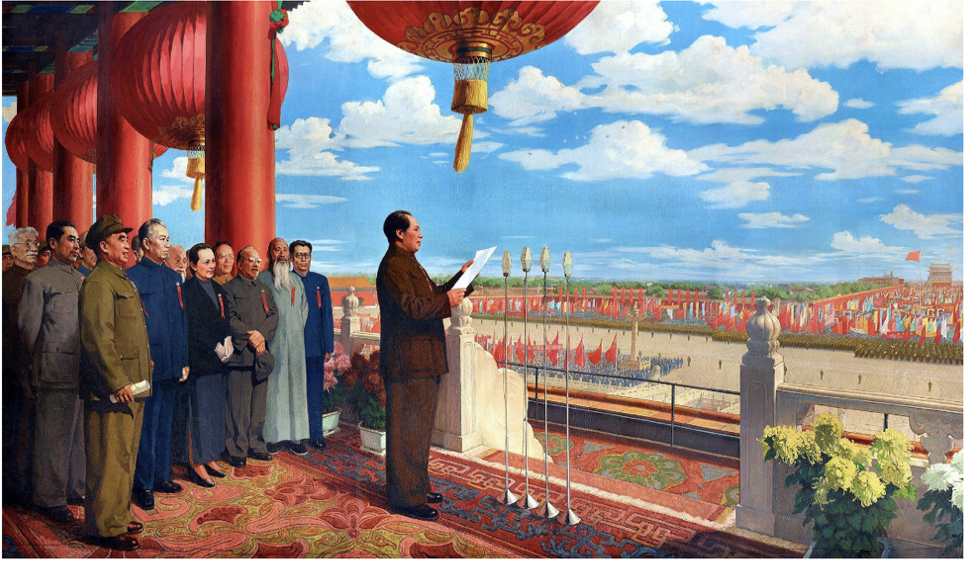
We can also see art being used as a form of propaganda before the cultural revolution through works such as The Founding of the Nation painted by Dong Xiwen in 1953 Figure 3. Mao is proudly standing onto of the Tiananmen which is the Gate of Heavenly Peace in Beijing as he delivers his lectures. He is surrounded by red lanterns which represent wealth and prosperity. The significance of the colour red is demonstrated later on within the Cultural Revolution as highlighted by Patricia Powell and Joseph Wong who argue that while artists followed the principles of social realism they also “proceeded to develop their own particular set of requirements: Mao’s face must always be painted as smooth, red, and luminescent-the obvious source of light, Mao is identified with the red sun rising in the east, the source of all good. Slogans such as “Mao is the reddest sun in our hearts” are represented on many posters by the Mao badge on the chests of workers or peasants”. This colour red was a beacon for positivity light and success.[10] The blue skies and the ordered citizens below further reinforce this notion of positivity and peace. This combined with the fact that he is surrounded by the support of communist officials and the location is a monumental place and symbol for China, highlights that Mao will lead a successful nation and would instil hope and belief into the viewer that is looking at the piece. It is interesting to note that the painting was altered as the officials in favour shifted over time. This reinforces the fact that it was understood that what was depicted in paintings mattered and it was necessary to keep these paintings relevant by having them accurately reflect the pollical climate at the time and there was no desire to have any trace of incorrect or expired ideological beliefs.

Figure 3
Dong Xiwen, The Founding of the Nation, 1953, copied by Jin Shangyi and Zhao Yu in 1972, and modified by Yan Zhenduo and Ye Welin in 1979, oil on canvas, 230 x 402 cm (National Museum of China, Beijing)

Prior to the Cultural Revolution Chinese art was deeply rooted in tradition with traditional art such as Traditional Chinese painting, calligraphy, music, and theatre. Mao Zedong however saw these traditions as embodying the old feudal order, which he sought to overturn in order to establish a socialist society. Through looking at the destruction of the old feudal, we can see a clear desire to break from the past as there was a call for an attack on the “four olds”, which were old customs, old habits, old cultures, and old thinking. Powell and Wong go on to explain that radicalised youths known as the Red Guards destroyed “old” buildings and “traditional” temples such as the temple of Confucius. “Students were encouraged to attack teachers, factory administrators, party members, and even their parents for “bourgeois” crimes. These crimes were defined by Mao and his supporters as anything from class background to collaborating with the Japanese in the 1930s. These attacks were initially verbal but, in some cases, escalated into actual physical violence”.[11] This demonstrated how the Red Guards were attacking the existing order and uprooting chinses and destroying the past in order to create and better communist future. 

In conclusion, the Cultural Revolution under Mao’s leadership marked a decisive break from the past in Chinese arts and society. By purging bourgeois elements and promoting proletarian culture, Mao sought to establish a socialist society grounded in revolutionary ideology. The proliferation of propaganda posters served as a powerful tool to disseminate Mao’s messages and cultivate a cult-like devotion to his leadership. This politicization of art and the indoctrination of the masses underscored Mao’s understanding of the strength of visual propaganda in shaping public consciousness. While the Cultural Revolution accelerated this cultural shift, it also built upon trends initiated by the Communist Party’s rise to power in 1949. Through the destruction of traditional customs and the elevation of revolutionary ideals, Mao consolidated his power and drastically transformed China’s cultural landscape.

Bibliography

Benewick, R. (1999). “Icons of Power: Mao Zedong and the Cultural Revolution,. In H. Evans, & S. Donald, Picturing power in the People’s Republic of China: posters of the Cultural Revolution (pp. 123-137). Oxford: Rowman & Littlefield Publisher .

Evans, H., & Donald, S. (1999). Introducing Posters of China’s Cultural Revolution. In H. Evans, & S. Donald, Picturing power in the People’s Republic of China: posters of the Cultural Revolution (pp. 1-127). Oxford : Rowman & Littlefield Publsihers.

Tse-tung, S. w. (1967). Zedong Mao. Foreign Languages Press : Perking.

Wong, P. P. (1997). Propaganda Posters from the Chinese Cultural Revolution. The Historian, 777–794.


[1] Wong, P. P. (1997). Propaganda Posters from the Chinese Cultural Revolution. The Historian, 777–794.

[2] Tse-tung, S. w. (1967). Zedong Mao. Foreign Languages Press : Perking.

[3] Tse-tung, S. w. (1967). Zedong Mao. Foreign Languages Press : Perking.

[4] Wong, P. P. (1997). Propaganda Posters from the Chinese Cultural Revolution. The Historian, 777–794.

[5] Evans, H., & Donald, S. (1999). Introducing Posters of China’s Cultural Revolution. In H. Evans, & S. Donald, Picturing power in the People’s Republic of China: posters of the Cultural Revolution (pp. 1-127). Oxford : Rowman & Littlefield Publsihers.

[6] Wong, P. P. (1997). Propaganda Posters from the Chinese Cultural Revolution. The Historian, 777–794.

[7] Wong, P. P. (1997). Propaganda Posters from the Chinese Cultural Revolution. The Historian, 777–794.

[8] Benewick, R. (1999). “Icons of Power: Mao Zedong and the Cultural Revolution,. In H. Evans, & S. Donald, Picturing power in the People’s Republic of China: posters of the Cultural Revolution (pp. 123-137). Oxford: Rowman & Littlefield Publisher .

[9] Wong, P. P. (1997). Propaganda Posters from the Chinese Cultural Revolution. The Historian, 777–794.

[10] Wong, P. P. (1997). Propaganda Posters from the Chinese Cultural Revolution. The Historian, 777–794.

[11] Wong, P. P. (1997). Prop